
CAT6 or CAT6A? Which Network Cable Should Your Business Install?
Key Takeaways:
- CAT6A supports 10 Gbps across the full 100-metre channel. CAT6 only reaches 10 Gbps on runs of roughly 37–55 metres.
- CAT6 is still a cost-effective choice for standard workstation, VoIP phone and printer drops. It supports 1 Gbps at 100 metres and 5 Gbps under IEEE 802.3bz.
- CAT6A is the recommended cable for Wi-Fi 6E and Wi-Fi 7 access points, which increasingly ship with 5 Gbps and 10 Gbps uplinks.
- High-power PoE, up to 90 watts per port under IEEE 802.3bt, generates heat in cable bundles, and CAT6A's larger conductor sizes and cable construction generally provide better thermal performance in high-density PoE bundles.
- For most commercial projects in Canada, CAT6A remains the highest commonly specified copper category for structured cabling systems. That makes CAT6A the better choice for certified, warrantable commercial systems.
- Most commercial buildings benefit from a mix of media: CAT6A for access points and ceiling devices, CAT6 for desk drops, and fiber for backbone links.
- In Canada, FT4-rated cable is commonly specified for riser applications, while FT6-rated cable is typically required in plenum air-handling spaces, subject to local code requirements and Authority Having Jurisdiction (AHJ) approval.
When you're planning an office fit-out, warehouse expansion, or full cabling refresh, the CAT6 vs CAT6A decision will be one of the first you’ll have to make. It shapes how your network performs for the next 15 years or more. The two cables look almost identical, both terminate with RJ45 connectors, and both get marketed as "future-proof." Inside a commercial building running Wi-Fi 7 access points, PoE security cameras and 10Gb switching, though, the differences can be significant.
In an earlier post, we explained how CAT6 cabling helps future-proof your business. This guide takes the next step. It compares CAT5e, CAT6, CAT6A and CAT7 side by side so that you, as a facility manager, IT lead or project team, can choose the right category for your commercial or enterprise environment.
CAT6 vs CAT6A: What's the Difference?
| Category | Bandwidth | 10 Gbps Distance | Best Commercial Use |
|---|---|---|---|
| CAT5e | 100 MHz | Not rated | Legacy only |
| CAT6 | 250 MHz | Roughly 37–55 m | Workstations, VoIP phones, general data |
| CAT6A | 500 MHz | Full 100 m | Wireless access points, high-power PoE, 10Gb drops |
| CAT7 | 600 MHz | 100 m | Not recognized for structured cabling in North America |
CAT5e vs CAT6: Why CAT5e Has Aged Out of Commercial Builds
CAT5e was the default for years, and plenty of buildings still run on it throughout Canada and the GTA. It's rated for 100 MHz and 1 Gbps. It can often carry 2.5 Gbps, but it was never designed for the multi-gigabit loads that modern access points and switches now expect.
CAT6 raises bandwidth to 250 MHz and uses tighter twists and better pair separation to cut crosstalk. In a new commercial installation, the material difference between CAT5e and CAT6 is small compared to the time and cost of pulling cable. In other words, that leaves very little reason to go with CAT5e today. If your building still runs on it, that's usually a sign the cabling plant is due for review rather than expansion.
CAT6: Still the Workhorse for Many Offices
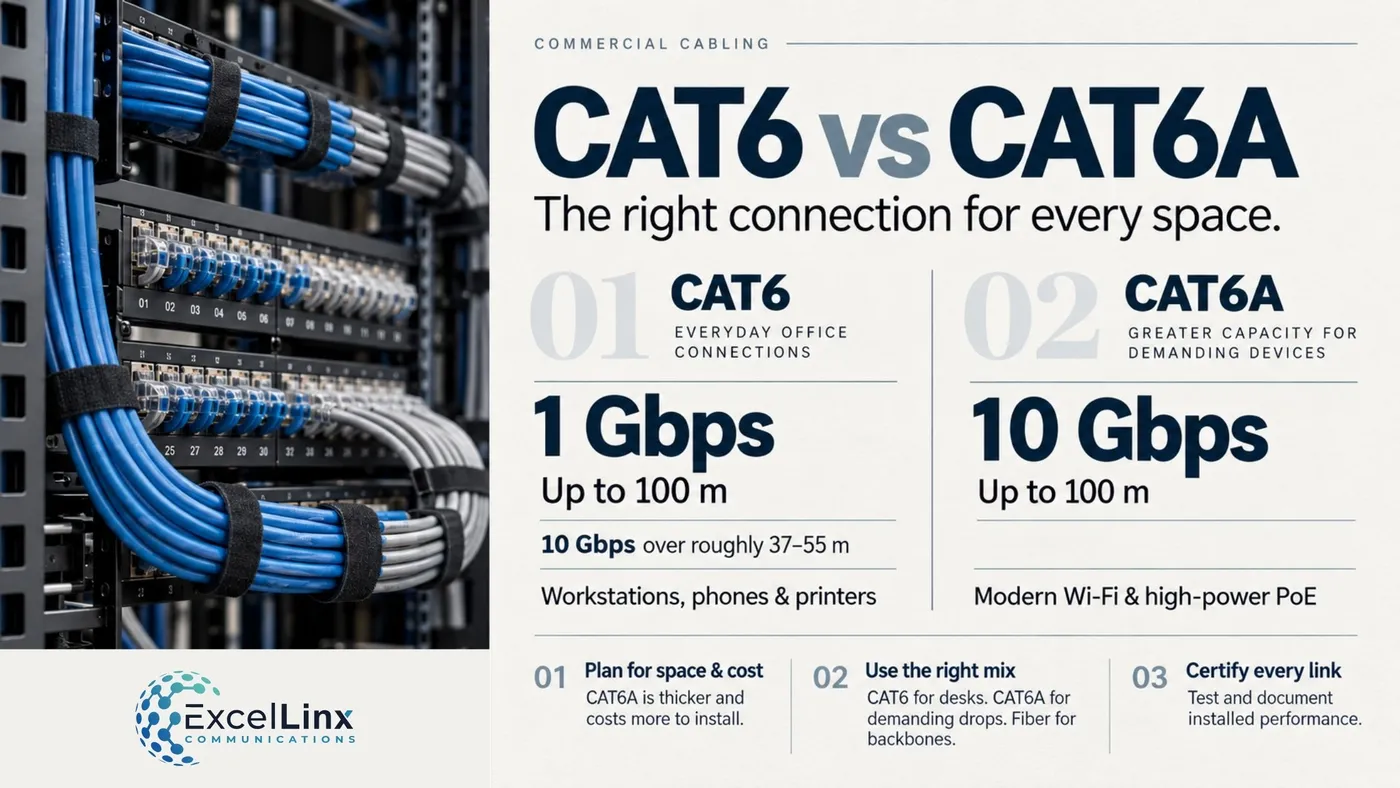
CAT6 remains a solid, cost-effective choice for a large share of commercial drops. It handles 1 Gbps across the full 100-metre channel and supports 5 Gbps under the IEEE 802.3bz standard. That covers most workstations, VoIP phones, printers and badge readers.
Its limits start showing at 10 Gbps. CAT6 can carry 10GBASE-T only over shorter runs, typically 37 to 55 metres. The exact length depends on how much alien crosstalk it picks up from neighbouring cables in the bundle. On a large floor plate, runs from the telecom room can often reach 90 metres, so that ceiling might be tested sooner than expected.
For desk-level connectivity in a standard office, professional CAT6 cabling installation still delivers excellent value, as long as it's designed, terminated and tested properly.
CAT6A: Built for Wi-Fi 6E, Wi-Fi 7 and 10Gb
CAT6A doubles bandwidth to 500 MHz and supports 10 Gbps across the full 100-metre channel. It achieves this performance through improved shielding or pair separation that controls alien crosstalk, which is why CAT6A is noticeably thicker than CAT6.
Why Wireless is Pushing Commercial Buildings to CAT6A
- Faster access points. Enterprise Wi-Fi 6E and Wi-Fi 7 access points increasingly ship with 5 Gbps and 10 Gbps uplink ports.
- More spectrum. In 2021, Innovation, Science and Economic Development Canada opened the 6 GHz band to licence-exempt Wi-Fi, giving access points much wider channels.
- The cable becomes the bottleneck. That extra wireless capacity only helps if the cable connecting each access point can keep up.
- CAT6A is the standard answer. Telecommunications Industry Association guidance recommends CAT6A for new access point connections.
How Far Each Cable Carries an Access Point Uplink
| Uplink speed | CAT6 | CAT6A |
|---|---|---|
| 1 Gbps | 100 m | 100 m |
| 5 Gbps | 100 m | 100 m |
| 10 Gbps | 37–55 m | 100 m |
At 10 Gbps, CAT6 falls short of the longest ceiling runs to access points, which can reach around 90 metres. CAT6A covers the full 100-metre channel at every speed.
Placement matters just as much. Cable category is only half the equation. Where and how access points are mounted is covered in our guide to strategic access point deployment.
Cable every ceiling location once. For offices, warehouses, retail locations and campuses planning commercial wireless deployments, running CAT6A now avoids reopening ceilings to re-cable in five years.
PoE, Heat and Why Cable Category Matters More Than It Used To
Power over Ethernet (PoE) now runs far more than phones. Access points, PTZ cameras, door controllers and digital signage all draw power over the same cable that carries their data. The IEEE 802.3bt standard allows up to 90 watts per switch port.
More power, however, means more heat. When dozens of PoE cables are bundled through a ceiling or riser, temperature becomes a point of consideration. Warmer copper has higher resistance, resulting in greater signal loss, which can shorten usable distance. CAT6A's larger construction generally dissipates heat better than CAT6, giving you more breathing room in dense bundles.
If your CCTV camera installation includes high-power multi-sensor or PTZ cameras, you’ll need to factor in PoE load during the design phase.
CAT6 vs CAT7: The Category That Isn't a Standard
CAT7 sounds like an obvious upgrade, but for commercial structured cabling in Canada, it's often the wrong choice. CAT7 is defined under the international ISO/IEC standard. However, it’s not recognized by TIA-568 or its Canadian counterpart, CSA T529, published by CSA Group.
True CAT7 systems were also designed around non-RJ45 connectors. Many "CAT7" patch cords sold online are simply relabelled cable with RJ45 plugs that don't meet the specification.
For buildings requiring certified, warrantable performance, CAT6A delivers 10 Gbps on a recognized standard with RJ45 compatibility. For anything faster, such as backbone or data centre links, fiber is the better path. Our business guide to structured cabling standards explains how these standards shape a compliant design.
What Are the Disadvantages of CAT6A?
CAT6A isn't perfect, and the trade-offs are practical ones:
- Size and weight. The larger diameter fills cable trays, J-hooks and conduit faster, so pathways may need to be sized up.
- Cost. Material costs run higher than CAT6, and termination takes more time and skill.
- Installation care. Bend radius, pull tension and bundling practices matter more, and poor workmanship is exposed quickly in test results.
- Matched components. CAT6 and CAT6A both use RJ45 connectors, but jacks, patch panels and patch cords must all be CAT6A-rated for the channel to perform as CAT6A.

A Practical Approach for Commercial Buildings
Most commercial projects shouldn’t rely on one answer for every drop. A common, cost-conscious design uses three media:
- CAT6A for wireless access points, ceiling-mounted devices, high-power PoE and any location likely to need 10 Gbps.
- CAT6 for standard workstation and phone drops where budgets are tight and runs are short.
- Fiber for backbone links between telecom rooms and floors.
Whatever mix you choose, two details are important for protecting your investment. First, specify the correct jacket rating. In Canada, FT4-rated cable is typically required for vertical riser runs and FT6 for plenum air-handling spaces.
Second, insist on certification. Every link should be tested with a Fluke certification tester and documented. That gives you proof that the installed system meets its category, not just the cable box it came in. As a CommScope-certified installer, ExcelLinx designs structured data cabling systems that qualify for manufacturer-backed warranties.
Upgrading an Existing Building?
If your building is using CAT5e or early CAT6, you don't have to re-cable everything all at once. Start with access point and camera locations, then phase desk drops floor by floor to keep disruption low. We walk through that process in our post on how to upgrade network cabling without disrupting daily operations.
Get the Right Cable Specified the First Time
Cabling is one of the longest-surviving components of your network. Switches and access points get replaced every five to seven years, but the cable behind them often lasts for two decades. Choosing between CAT6 and CAT6A with your wireless, PoE and growth plans in mind is one of the most cost-effective decisions you'll make.
Need help deciding between CAT6 and CAT6A? ExcelLinx designs, installs, tests, and certifies structured cabling systems across Toronto, the GTA, and nationwide. Contact our team for a site assessment and cabling recommendation.
Frequently Asked CAT6 vs CAT6A Questions
What is the difference between CAT6 and CAT6A?
The main difference is the 10 Gbps distance. CAT6A supports 10 Gbps across a full 100-metre channel, while CAT6 supports 10 Gbps only up to roughly 37–55 metres. CAT6A also doubles bandwidth from 250 MHz to 500 MHz and controls alien crosstalk better, which is why it's thicker and costs more to install.
Is CAT6A much better than CAT6?
For commercial buildings running 10Gb switching, Wi-Fi 6E or Wi-Fi 7 access points, or high-power PoE devices, CAT6A is significantly better. For standard workstation and phone drops that need 1 Gbps, CAT6 performs just as well at a lower cost. Many businesses install both, matching each cable to what the drop needs to support.
Is CAT6A overkill for an office?
CAT6A isn't overkill for access points, security cameras or other ceiling-mounted devices in a modern office. These locations increasingly need multi-gigabit speeds and higher PoE power. It can be more than you need for basic desk drops on short runs. A mixed design with CAT6A where it matters and CAT6 elsewhere keeps costs in check without limiting growth.
What are the disadvantages of CAT6A?
CAT6A's main disadvantages are practical. It's larger and heavier than CAT6, so it fills cable trays and conduit faster. Material and labour costs are higher, and it requires more care with bend radius and pull tension. Every component in the channel, including jacks, patch panels and patch cords, must be CAT6A-rated to achieve CAT6A performance.
Do CAT6 and CAT6A use the same connector?
Yes. Both CAT6 and CAT6A use RJ45 connectors, so they're physically compatible with the same equipment. To get certified CAT6A performance, though, every jack, patch panel and patch cord in the link must be rated CAT6A. Mixing in CAT6 components limits the whole channel to CAT6 performance.
How long can a CAT6 cable run?
A CAT6 cable can run up to 100 metres at 1 Gbps. That typically means a 90-metre permanent link plus 10 metres of patch cords. At 10 Gbps, CAT6 is limited to roughly 37–55 metres, depending on crosstalk from neighbouring cables. For 10 Gbps runs longer than that, CAT6A or fiber is the right choice.
Is CAT6 better than CAT5e?
Yes. CAT6 offers 250 MHz of bandwidth compared to CAT5e's 100 MHz. It also reduces crosstalk and supports speeds up to 10 Gbps on shorter runs, while CAT5e is designed for 1 Gbps. For new commercial installations, the cost difference is small relative to labour, so CAT5e is rarely worth specifying today.
Is CAT7 better than CAT6A?
Not for commercial structured cabling in North America. CAT7 is defined by ISO/IEC but isn't recognized by TIA-568 or CSA T529. True CAT7 was also designed around non-RJ45 connectors. CAT6A delivers the same 10 Gbps at 100 metres on a recognized, warrantable standard. For speeds beyond 10 Gbps, fiber is the better option.