

Slow file transfers, dropped video calls, and networks that buckle under new devices aren’t just frustrating; they’re signals that your network infrastructure is lagging behind your business. Growth today is digital-first, and the wiring behind your walls determines how far and how fast you can scale. The right cabling decision for your industrial, commercial, retail, or public organization needs to address more than simply keeping up; it needs to factor in staying ahead of what your operations will demand next. For many organizations across industries, CAT6 cabling is the best answer.
Making Future-Proof Cabling Decisions
Businesses often underestimate how quickly bandwidth demands compound. A single office upgrade, like adopting cloud-based platforms or adding IoT devices, can double or triple network load without warning.
What matters most is planning for aggregate demand, not just individual device usage. A VoIP phone might be lightweight on its own, but combine that with video conferencing, cloud backups, wireless access points, and security systems, and your network cabling becomes the backbone supporting everything simultaneously.
Scalability
A future-ready system should allow for expansion without ripping open walls or replacing entire runs. This is where structured cabling design plays a critical role. Proper pathway planning, cable management, and labelling ensure that upgrades later are surgical, not disruptive.
Factoring Lifecycle Cost
Choosing lower-grade cabling may reduce upfront spend, but it often leads to premature replacement when network standards advance. In contrast, investing in higher-performance cabling extends usability and reduces long-term operational friction.
Finally, compliance and standards matter more than most businesses realize. Adhering to TIA, ANSI, CSA/CEC guidelines ensures compatibility with evolving technologies and prevents bottlenecks caused by mismatched infrastructure. Working with an experienced partner like ExcelLinx Communications ensures your cabling decisions are aligned with both current requirements and what your network will need next.
An Overview of CAT-6 Cabling
CAT6 cabling is a twisted-pair Ethernet standard designed to support high-speed data transmission with reduced interference. It builds on earlier categories by improving internal construction, specifically tighter twists and better insulation between wire pairs.
At a technical level, CAT6 supports speeds up to 1 Gbps at 100 meters and can handle 10 Gbps over shorter distances, typically up to 55 meters in controlled environments. This makes it a strong middle ground between cost and performance.
Performance
One of the defining features of CAT6 is its ability to minimize crosstalk. Internal separators or spline structures help isolate signal paths, which is critical in environments where multiple cables run in parallel. This translates to more stable connections, especially in dense network deployments.
CAT6 also supports higher bandwidth, up to 250 MHz, allowing it to carry more data simultaneously compared to CAT5e. This becomes increasingly important as businesses adopt bandwidth-intensive applications like real-time collaboration tools and high-resolution media streaming.
Importantly, CAT6 is backward compatible. It integrates seamlessly with existing network equipment, which simplifies upgrades without requiring a full system overhaul.
Benefits of CAT-6 for Business Networks
CAT6 is about more than faster speeds, and more about network reliability under pressure. Here’s a quick breakdown of the advantages businesses gain with CAT6 cabling.
Consistent Performance Across Devices
CAT6 maintains stable throughput even when multiple endpoints are active, preventing the kind of slowdowns that occur when networks become saturated.
Reduced Signal Interference
Office environments are full of potential interference sources, from electrical systems to wireless equipment. CAT6’s enhanced shielding and internal structure significantly reduce crosstalk and electromagnetic interference, leading to fewer packet losses and retransmissions.
Support for Power over Ethernet (PoE)
Modern workplaces rely heavily on PoE for devices like IP cameras, VoIP phones, and wireless access points. CAT6 supports higher PoE standards more efficiently, delivering both data and power without compromising performance.
Improved Network Longevity
CAT6 provides a longer usable lifespan compared to older standards. As software and cloud services evolve, the demand for bandwidth increases. CAT6 ensures your infrastructure can handle these shifts without immediate replacement.
Better Support for High-Density Environments
In offices with dozens or hundreds of connected devices, CAT6 handles data aggregation more effectively. It prevents congestion at the cabling level, which is often overlooked when diagnosing network slowdowns.
Best Use Cases for CAT-6 in Businesses
CAT6 is versatile, but its value becomes clear in specific operational scenarios.
Office Workstations and Collaboration Spaces
For general office environments, CAT6 delivers reliable connectivity for day-to-day tasks like cloud applications, video conferencing, and file sharing. It ensures employees don’t experience performance drops during peak usage.
Wireless Access Point Backhaul
Wi-Fi performance depends heavily on wired backhaul. CAT6 provides the bandwidth needed to support high-performance access points, especially in Wi-Fi 6 deployments where throughput demands are significantly higher.
Security and Surveillance Systems
IP cameras generate continuous data streams. CAT6 supports both the bandwidth and PoE requirements needed for high-resolution video monitoring without signal degradation.
Retail and Point-of-Sale Systems
Retail environments require consistent uptime for transactions, inventory systems, and customer Wi-Fi. CAT6 ensures these systems operate without latency that could impact customer experience or sales.
Light Industrial and Warehousing
In environments where IoT devices and scanning systems are common, CAT6 supports reliable communication between endpoints, ensuring operational workflows remain uninterrupted.
CAT-6 vs. Other Cabling Options
A better understanding of where CAT6 fits into the world of structured cabling can often begin with comparing it to alternatives. Choosing the right cabling is about matching performance characteristics to how your network is actually used day to day.
CAT5e
CAT5e is best suited for small offices or low-demand environments where network usage is limited to basic tasks like email, light cloud access, and standard-definition VoIP. It works well in temporary setups or legacy systems where upgrading isn’t immediately feasible. However, it becomes a constraint when multiple users begin accessing bandwidth-intensive applications simultaneously, making it a short-term solution rather than a strategic one.
CAT6a
CAT6a is often used in high-performance environments where sustained data throughput is critical, such as engineering firms, media production studios, and enterprise offices with heavy internal data transfer. It’s also a strong fit in buildings with plans for long-term infrastructure with minimal future upgrades. Its ability to maintain 10 Gbps over longer distances makes it valuable in larger floor plans or multi-zone deployments.
Fiber Optic Cabling
Fiber offers unmatched speed and distance capabilities, making it ideal for backbone connections between buildings or data centers. However, it’s typically overkill for endpoint connections within a standard office due to cost and complexity. Fiber optic cabling is most appropriate for network backbones, inter-building connections, and data-intensive operations where distance and speed are non-negotiable. It excels in campuses, warehouses, and data centers where traditional copper cabling would introduce latency or signal degradation. Fiber is also the preferred option when electromagnetic interference is a concern, such as in industrial environments with heavy machinery.
Where CAT6 Fits
CAT6 strikes a balance between performance, cost, and practicality. It delivers enough headroom for most business applications without the installation challenges of higher-tier options, like Cat6a.
Installation Best Practices for CAT-6
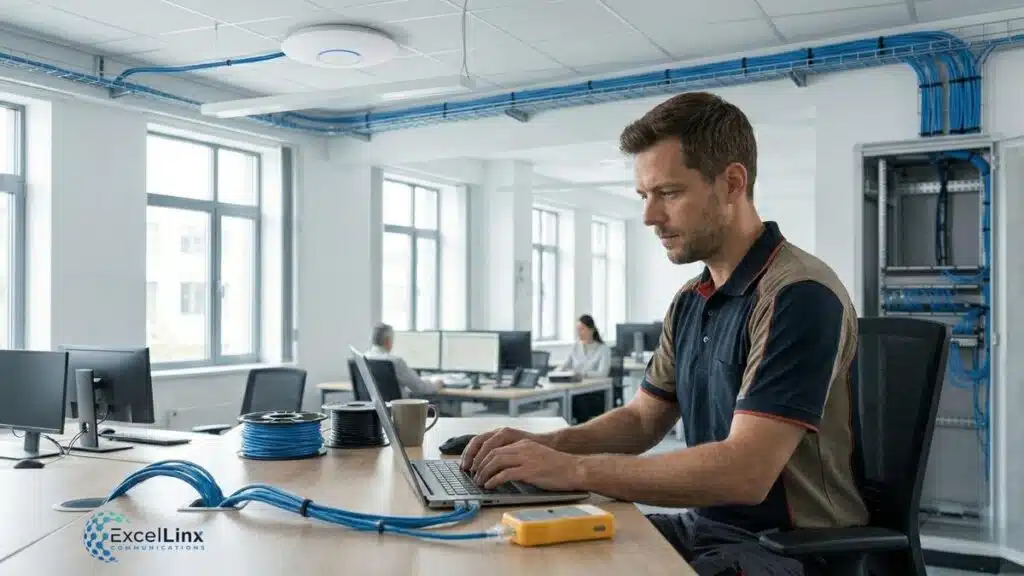
Proper installation is what determines whether CAT6 performs to its full specification or falls short under real-world conditions. Attention to detail during deployment directly impacts long-term reliability, scalability, and troubleshooting efficiency.
Maintain Proper Bend Radius
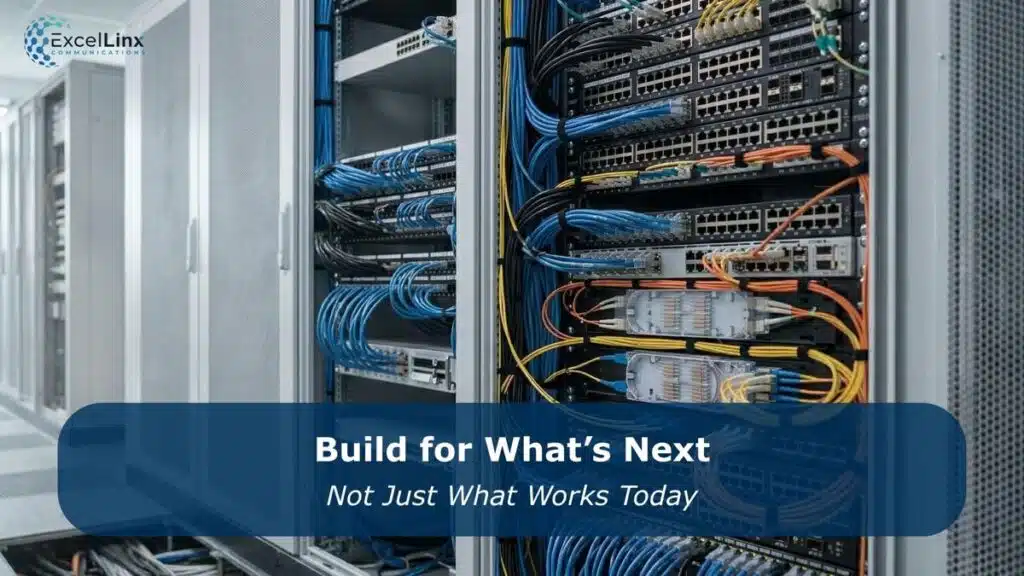
Cables should never be bent beyond their recommended radius, as this can distort the internal geometry and impact signal transmission. Even minor deviations can introduce performance inconsistencies that are difficult to diagnose later. Using structured pathways like cable trays or conduits helps maintain consistent routing and reduces the risk of accidental stress during future maintenance.
Avoid Tight Bundling
Grouping too many cables tightly together can increase heat buildup and signal interference between runs. This becomes especially problematic in high-density installations where thermal accumulation is harder to dissipate. Using proper spacing and cable management hardware ensures airflow is maintained and performance remains stable across all connections.
Use High-Quality Terminations
Connectors, jacks, and patch panels must be rated for CAT6 to maintain end-to-end performance integrity. Inconsistent or poorly executed terminations can introduce impedance mismatches that degrade signal quality. Standardizing components across the installation also simplifies troubleshooting and reduces variability in network performance.
Keep Distance from Electrical Interference
Ethernet cabling should be routed away from power lines, fluorescent lighting, and heavy electrical equipment to minimize electromagnetic interference. Even intermittent exposure to interference sources can cause packet errors that affect application performance. Strategic pathway planning during installation helps avoid these issues without requiring retroactive fixes.
Test and Certify Every Run
Each cable run should be tested using certification tools to confirm it meets CAT6 performance standards. This process identifies issues like attenuation, crosstalk, or improper terminations before they impact operations. Documenting these results also provides a baseline for future diagnostics and network audits.
Plan for Accessibility
Cabling should be installed in a way that allows for easy access during upgrades or maintenance. Hidden or hard-to-reach runs increase downtime and complicate even minor changes. Designing with accessibility in mind ensures the network can evolve without unnecessary disruption to business operations.
When to Consider Upgrading Beyond CAT-6
CAT6 meets the needs of most business environments, but certain conditions push beyond its practical limits. Recognizing these scenarios early helps avoid performance ceilings that can’t be resolved without significant infrastructure changes.
High-Speed Data Environments
If your business relies on large-scale data transfers, such as media production or data analytics, CAT6a or fiber may be necessary to support sustained 10 Gbps speeds over longer distances.
Large Facilities or Campus Networks
Fiber or higher-category cabling allows for seamless connectivity across long distances without the need for intermediate hardware. This reduces points of failure and simplifies network architecture.
Future-Heavy Technology Adoption
Organizations planning for advanced technologies like AI-driven systems, edge computing, or dense IoT ecosystems may benefit from higher-capacity cabling to avoid future bottlenecks.
Data Centers and Server Rooms
High-density environments with heavy traffic loads often require the performance guarantees provided by CAT6a or fiber; the key is aligning your cabling choice with your projected ceiling, not your current floor.
Bottom Line,
Infrastructure decisions have a way of showing their impact later, when changes are harder and more expensive to make. The businesses that stay ahead are the ones that treat cabling as a long-term asset, not a short-term requirement. If you’re ready to build a network that scales without friction, reach out, and let’s design it properly from the ground up.